Bulk-generate & schedule posts in seconds with Smart Scheduling. Try now!
Evergreen content: How to create Long-lasting traffic for your website
 Published by Sadia
If you are new to marketing, you might not be familiar with evergreen content. It’s a core concept in content marketing and one of the most important building blocks of a long-term content strategy.
Unlike trend-driven posts, evergreen content stays relevant for months or even years. When you create it well, it continues to attract traffic, generate leads, and help you boost SEO long after the publish date.
In this guide, you’ll learn what evergreen content is, why it matters, how to create it step by step, and plenty of evergreen content ideas and examples you can borrow for your own brand. By the end, you’ll know how to build an evergreen content engine instead of constantly chasing short-lived trends.
Related Read: 30 evergreen content ideas for content marketing.
What is evergreen content?
Evergreen content is content that remains useful and relevant over a long period. The name comes from evergreen trees that stay green all year round. In the same way, evergreen articles, videos, or podcasts continue to answer the same recurring questions your audience has, regardless of the season or news cycle.
Evergreen content answers timeless questions like “how,” “what,” and “why” rather than covering breaking news. It focuses on fundamentals and principles that change slowly. It does not depend on specific dates, events, or short-lived trends. It can be lightly refreshed over time without needing a full rewrite.
Examples include:
- How to write a resume
- Beginner’s guide to email marketing
- What is content marketing?
These are evergreen topics because people search for them year after year, and the basics rarely change.
It is often easier to compose something in ContentStudio once and then update or re-share it as needed, rather than starting from scratch every time you want to discuss the same idea. That’s the mindset behind evergreen content.
Many marketers feel that blogging or social media marketing “doesn’t work” for them. Often, the problem is not a lack of effort; it’s a lack of evergreen content that continues to work long after the initial promotion.
Why is evergreen content important?
Evergreen content sharing is of utmost importance for digital marketers who need to reach and engage the public. Many businesses handle the hard part by creating content with the help of generative AI tools for content writing, but they’re reluctant to share it multiple times. And they justify it by saying that they don’t want their audience to think that their content is monotonous.
This misjudgment costs them a lot by failing to achieve a worthwhile result from their campaign. To the marketer’s utter shock, it turns out that the general audience sees only 10% of their posts. That means most of their valuable content goes in vain. Nobody wants to sow fruitless seeds, so in order to gain fruitful results, re-sharing must be your new mantra.
If sharing is caring about others, then re-sharing is caring about yourself.
Related: 5 Major Steps to Content Curation: A Beginner’s Guide To Content Curation
Evergreen content vs trending and seasonal content

To build a strong content strategy, you need to understand how evergreen content compares to other content types you might publish.
Evergreen content
- Focuses on timeless, foundational topics.
- Attracts steady, consistent search traffic over time.
- Needs only occasional updates to stay accurate.
Example of evergreen content:
A detailed guide on “How to build an email list from scratch.” The basic principles of list building don’t change quickly, so the article can serve readers for years.
Seasonal content
- Performs well during specific times of year.
- Tied to holidays, seasons, or recurring events.
- Traffic spikes, then drops until the next season.
Examples:
- “Black Friday marketing ideas for e-commerce brands.”
- “Back-to-school social media campaign checklist”
Seasonal content is useful, but it isn’t evergreen because interest is limited to a short, predictable window.
Trending or news-driven content
- Centers on breaking news, viral topics, or fast-moving trends.
- Can deliver a surge of traffic quickly.
- Becomes outdated quickly.
Examples:
- Coverage of a major social network algorithm change.
- Commentary on a viral meme.
- “Top SEO trends for 2024.”
Trending content can build short-term attention and show that your brand is current, but it doesn’t provide the same long-term value as evergreen content.
A healthy content strategy usually blends all three, with evergreen content serving as the stable foundation that continues to drive traffic and leads year-round.
Why is evergreen content important?

So why invest time in evergreen topics instead of pushing out only news or trend pieces?
Evergreen content matters for several reasons:
1. Consistent organic traffic
Because evergreen topics have steady search demand, a well-written article can rank for years. Instead of short traffic spikes, you get a continuous flow of visitors who discover your brand through search, social, or referrals.
2. Stronger ROI from each piece
Evergreen content may take longer to research and write, but that effort pays off over time. One high-performing article can generate traffic, leads, and sales long after the initial launch, especially if you maintain and re-share it.
3. Less content burnout
If you only cover news and trends, you’re always on a treadmill. Evergreen content lets you build a library of assets that keep working for you so you’re not constantly scrambling for the next big story.
4. Authority and trust
Publishing in-depth, evergreen content on core topics in your niche signals expertise. Over time, your audience (and search engines) learn that your brand is a reliable source of answers, which supports rankings, referrals, and sales.
“Quality content means content that is packed with clear utility and is brimming with inspiration, and it has relentless honesty.” — Ann Handley
5. More value from every channel
Evergreen posts are easy to repurpose into email sequences, social media content, lead magnets, and sales enablement assets. You can keep sharing and reusing them because they’re rarely outdated.
If sharing is caring about others, then re-sharing evergreen content is caring about your business.
How to write evergreen content

Writing evergreen content is about much more than avoiding dates or current events. It’s about creating content that solves enduring problems better than anyone else.
A secret to writing evergreen content
The real secret to evergreen content is simple: tell clear, memorable stories that deliver lasting value.
To do that:
- Study your industry deeply so you understand the fundamentals, not just the latest hacks.
- Translate that knowledge into simple explanations that a beginner can understand.
- Use examples and stories that will still make sense years from now (avoid memes or hyper-current references).
- Focus on solving a complete problem in one place, so readers don’t need to click away to other sites.
When you become the go-to resource for a core concept, that piece of content turns into a long-term asset.
Find out what people ask about most frequently
Evergreen ideas start with real, recurring questions from your audience.
You can find these questions by:
- Talking to your sales and support teams about what prospects ask most.
- Reviewing comments in your social media communities and industry Facebook or LinkedIn groups.
- Checking Q&A sites like Quora and Reddit.
- Exploring “People also ask” boxes and related searches in Google.
- Using SEO tools to discover question-based keywords.
For example, if your customers constantly ask about shipping costs, taxes, or delivery times, you can turn that into:
- A detailed FAQ page on your website.
- An in-depth guide on “How our shipping and delivery process works.”
- A short explainer video for social media.
These are all evergreen content ideas because people will always want clear answers to these questions.
Start with the value proposition behind what you offer
Features change. Platforms evolve. But the core value you deliver to customers stays fairly stable.
That’s why strong evergreen content starts from your value proposition:
- What problem do you solve?
- Why do customers choose you instead of a competitor?
- What results do you help them achieve?
Build content around those enduring benefits. For example:
- A project management tool can publish evergreen guides on productivity, prioritization, and team communication.
- A boat retailer can focus on buying guides, maintenance checklists, and safety tips.
Features come and go, but the need for those results doesn’t.
What are the common formats of evergreen content?

Some formats naturally work well for evergreen content. Choosing the right format for your topic will help keep the content relevant and helpful over time.
Here are popular evergreen content formats, with evergreen content examples and ideas for each:
- List posts
List posts are easy to skim and remember. They usually have high engagement and can rank for multiple related keywords.
You can create lists of almost anything, including useful content marketing tools, recommended books, or industry resources.
For example, The Dog Book Company created a long, detailed list of interesting dog facts that dog lovers can enjoy any time of year. - “How to” tutorials and guides
These posts walk readers through a process step by step. As long as the underlying process doesn’t change much, the content stays evergreen.
Example of evergreen content: a complete “How to start a blog” guide. The tools might change, but the overall process remains similar. - Encyclopedia-style explainers
These focus on definitions, unchanging facts, and core concepts. Think of them as “what is” articles for your niche.
They can include historical context, terminology, and key principles that rarely shift. - Video content and podcasts
How-to videos, tutorials, and educational podcasts often work well as evergreen content because people continue to search for those topics.
Examples include “how to grout floor tiles” or “how to frost a cupcake.”
To create strong evergreen videos, you can use an online video makerto add simple effects and branding. Also, remember that a large portion of your audience prefers audio and video content over text. - Glossary posts
A glossary that explains key terms in your industry is one of the most powerful evergreen content ideas.
Teachers, translators, students, and beginners rely on glossaries to understand jargon, and those definitions rarely need major changes. - Case studies
Case studies share real-world stories and results. They can be evergreen if they highlight principles or strategies that still apply.
Marketers study them to see what works before planning campaigns, and research on B2B content and marketing trends shows that case studies remain one of the most trusted content formats for decision-makers. The data helps them decide where to invest time and budget.
Click here to see an example related to this content format. - Answer-based posts (Q&A)
Content built around questions is naturally evergreen because people always search for answers.
Browse platforms like Quora or niche forums, find questions you can solve, and publish detailed responses on your site. You can then repurpose those posts into shorter answers on Q&A platforms that point back to your content. - Historical content
Historical overviews of your industry, products, or techniques can be evergreen, as long as you avoid time-stamped words like “recently” or “last year.”
Instead, use specific dates or neutral phrasing so the piece doesn’t sound outdated. - Top (X) lists
“Top 10” or “Top 25” style posts are another evergreen format. They help readers discover the best tools, blogs, books, or strategies on a particular subject.
As long as the topic isn’t time-bound (for example, “Top SEO tools for beginners”), the post can stay useful for years with periodic updates. - Interviews
Interviews with experts or customers can be timeless when they focus on big ideas, lessons learned, and evergreen advice.
You can repurpose an expert interview into a slide deck, an ebook, or even a white paper. - Curated resource hubs
Becoming a curator is another strong, evergreen idea. You gather the best resources on a topic into a single hub page so visitors don’t have to search all over the web.
Resource hubs can attract backlinks and become reference pages in your niche.
Choosing one of these formats doesn’t automatically make your writing evergreen, but these templates are a natural fit for evergreen topics.
When you need to show a process (like baking a cake), video, diagrams, or step-by-step photos will usually work better than text alone. Always pick the format that delivers the clearest, longest-lasting value.
One way to support your evergreen content is by using automation tools. For example, ContentStudio can help you queue and recycle your best posts across social channels for months at a time, so they continue to reach new audiences.
Related: How to Drive 4x Traffic to Your Blog With ContentStudio’s Evergreen Automation
12 tips for writing evergreen content
As digital expectations grow, readers want more than just data. They want content that answers their questions, respects their time, and feels relevant whenever they discover it.
Evergreen content is a powerful way to meet those expectations.
Below are 12 practical tips to help you create evergreen content that enhances user experience, improves search engine performance, and enhances your content marketing effectiveness.
1. Consider your audience
Start with your audience, not your topic.
- Who are you writing for: beginners, intermediates, or experts?
- What problems keep coming up in their day-to-day work?
- What questions do you hear repeatedly in sales calls or support tickets?
Any evergreen topic you choose should clearly solve a real problem or answer a recurring question. The more specific you are about who you’re speaking to, the easier it is to create content that stays useful.
2. Curate keyword-based content
Use search data to confirm that your evergreen ideas are worth writing about.
Creating content around relevant keywords that matter to your business helps search engines connect your site with people who need what you offer.
For example, if your site targets health and fitness, then evergreen topics like “best leg exercises,” “how to create a meal plan,” or “beginner strength training routine” are smart bets. These queries have steady interest over time.
Focus on:
- Long-tail keywords that reflect real questions, like “best leg exercises at home without equipment.”
- Keyword trends that show stable or gently rising interest, not seasonal spikes.
This way, your evergreen content ideas are backed by real search demand.
3. Update your content regularly
“Evergreen” doesn’t mean “never update.”
Even timeless topics can suffer from outdated statistics, examples, or screenshots. Plan to review your best evergreen pieces every 6–12 months and update:
- Stats, research, and data points.
- Screenshots and UI walkthroughs.
- Tools, pricing, or product details.
- Internal links to newer, related content.
If you wrote a video marketing article five years ago, some of the platforms, formats, or benchmarks you mentioned may no longer be accurate. A quick refresh can restore its value and rankings.
4. Make use of attractive and appropriate visuals
Visuals help your evergreen content stay engaging.
It’s not enough to publish a wall of text. Support your ideas with:
- Explanatory screenshots and diagrams.
- Before-and-after examples.
- Short GIFs or simple animations.
- Charts or visual summaries.
Use enough visuals to clarify your point without overwhelming the reader. The goal is to help them understand faster and remember longer.
5. Create relevant content
Relevance is the filter for every evergreen idea.
Your evergreen content should align with:
- Your brand’s expertise.
- The products or services you sell.
- The audience you want to attract.
For example, if you sell boats, writing about general home repairs is off-topic. But posts about sailing, fishing, boat maintenance, and safety are all strong evergreen topics for your brand.
Creating relevant and helpful content also trains your audience to associate your name with high-quality information in your niche.
6. Avoid writing about current events
If your goal is evergreen content, minimize references to:
- Breaking news.
- Temporary trends.
- Short-lived product features.
- Time-sensitive promotions.
When you tie a piece too closely to a specific moment, you shorten its lifespan. That doesn’t mean you should never cover news, it just shouldn’t be the foundation of your evergreen library.
Also, avoid keywords that include years or dates unless the topic itself is year-specific (for example, “tax deadlines 2024” is not evergreen).
7. Make your title catchy and clickable
Your title is the first (and sometimes only) thing people see.
A strong evergreen headline is:
- Descriptive (“How to write a blog post that ranks in Google”).
- Benefit-driven (“10 email marketing examples that double open rates”).
- Honest about what’s inside (no clickbait).
“Best of” and “how-to” titles often perform well for evergreen content because they clearly promise value. Just make sure the content delivers on the headline for years to come.
8. Don’t make use of technical language
Most evergreen content targets beginners or early-stage learners.
If your article is packed with jargon and acronyms, you’ll lose them fast. Instead:
- Use plain language wherever possible.
- Explain any technical terms you must include.
- Write like you’re talking to a smart friend who’s new to the topic.
Simple, accessible language helps your content stay relevant and readable over time.
9. Avoid writing only for experts
If you’re an expert, it’s tempting to write for other experts. But the largest audience for evergreen content is usually beginners.
Professionals rarely search for “what is…” articles. Newcomers do.
That doesn’t mean you can’t ever create advanced content. It means your core evergreen topics should focus on:
- Definitions and fundamentals.
- Step-by-step getting-started guides.
- Checklists and templates for beginners.
You can always link advanced content from those beginner pieces to create a natural learning path.
10. Link related posts together
Evergreen content rarely stands alone. It usually works best as part of a connected cluster.
If you write a broad guide like “A complete guide to bike care,” break it into supporting posts, such as:
- “How to replace your bike tire.”
- “How to oil your bike brakes.”
- “How to clean your chain and gears.”
Then link all these posts together. This:
- Helps users find exactly what they need.
- Increases page views and time on site.
- Sends strong topical signals to search engines.
11. Promote on social media
Evergreen content only works if people see it.
One of the best ways to extend its life is to share it continuously on your social channels with a posting plan, not just a one-time push.
You can use publishing or schedule tools to queue evergreen posts on Facebook, X (Twitter), LinkedIn, Instagram, Pinterest, YouTube, and more. Refresh the caption or creative periodically, but keep linking back to the same high-value resource.
This way, your evergreen articles continue to reach new followers and generate engagement long after the original publish date.
12. Repurpose the content
To get more value from each evergreen piece, repurpose it into new formats:
- Turn a blog post into a YouTube video or podcast episode.
- Break a long guide into a series of social posts or carousels.
- Convert a checklist into a printable PDF lead magnet.
- Turn a how-to article into a webinar or workshop outline.
Repurposing keeps your best evergreen ideas in circulation and reaches people who prefer different content formats.
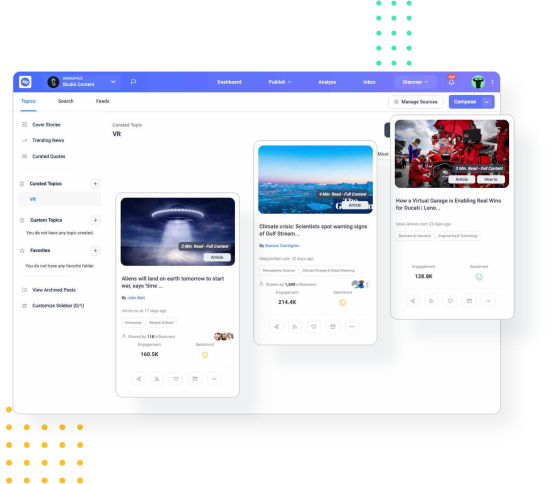
Build Trust with Curated Content
Discover, brand, and share the best content with your audience. Establish yourself as an authority and turn leads into loyal customers.
14 days free trial - no credit card requiredExamples of evergreen content
The information available in your writing makes your content evergreen. Some examples of evergreen are:
Example #1
Answer common questions
You may be surprised to know that some of the most common questions people ask in your niche or specialty can be easily answered on Google.
For example, if you frequent social media groups related to hosting events and want information about how much it costs per head for something like this, then just search “how much does one person cost at my event?”
Simple Pin Media has created an in-depth guide about Rich Pins on Pinterest. The company specializes in digital marketing tools, including this new feature for users looking to optimize their strategy around the popular social media site -Pinterest!
Simple pin offers tons of helpful information and resources specifically for those interested in or curious about how best to use the “rich” features available through their browser extension, “Rich Pings.”

Example #2
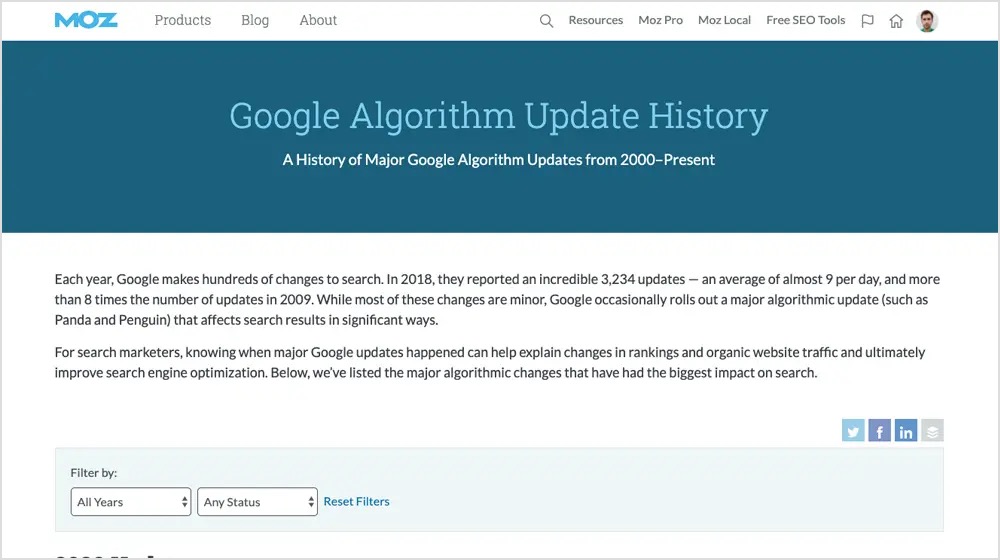
Moz’s Google algorithm updates the history
What are the impacts of Google algorithm updates?
Moz has tracked every major and most minor updates since 2000. This is a huge reference article with all sorts of interesting data about how search engines work!
This list of updates is evergreen because Google’s algorithm changes will be important as long as it exists. The document contains both modern information about what’s happening now and historical notes from years ago – perfect if you’re trying to find something specific that happened before this year!
Example #3
Ultimate guides
The “Ultimate Guide” is one of the best types and a great way to solve common problems and answer all your questions with in-depth explanations.
These guides will take you through each step, breaking it down into small pieces so that even if something doesn’t apply directly, there’s still hope for what could happen next!
Pat Flynn of Smart Passive Income does a great job at covering the process of creating and selling an online course. There are many steps involved with this task, but he covers them all so you can get your information out there!
The post also gets frequent updates in order to keep it valuable for audiences looking up how-to’s on different parts or completing their own courses as well.”

Example: 4
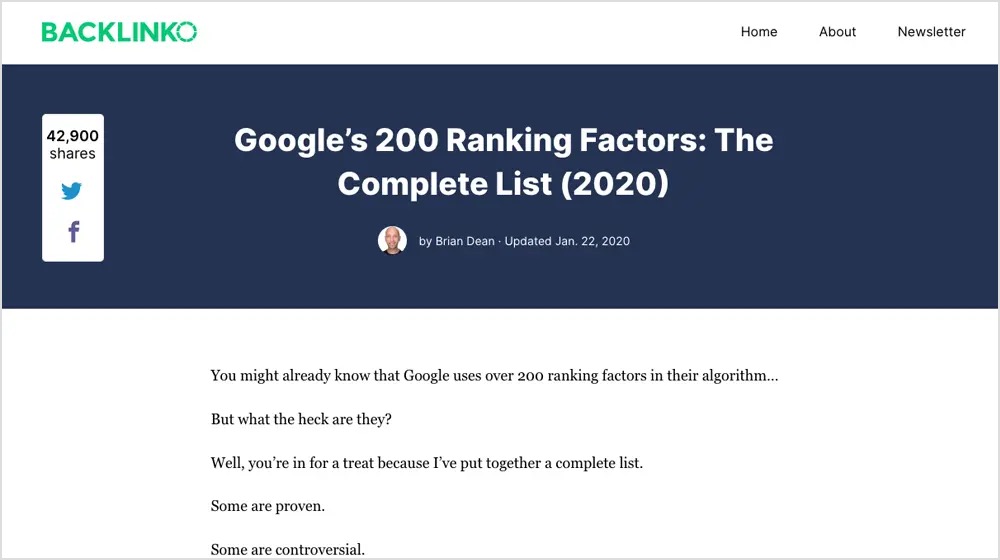
Backlinko’s List of Google ranking factors
This evergreen post is a great way to get your content in front of as many people as possible. Helpful articles and blog posts are an essential part of any SEO campaign. This one you’ve probably heard before, but it’s still worth a shot!
Google’s algorithm can be daunting to understand, but this article does a great job of breaking it down and explaining what goes into updating its program. You’ll find sources for all of these factors as well – linking you straight where they lead if need be!
This outstanding resource not only explains how Google decides which sites appear in search engine results pages (SERPs) but also provides detailed coverage of topics such as relevance theory and Community structural updates over the years, giving readers insight without confusion.
To know more about creating long-lasting content, you can visit the following sites, which are major producers of evergreen content:
These websites publish evergreen articles in huge quantities. For instance, Content ideas rank first in nearly half of Google searches. You can visit the sites mentioned above to see how they create evergreen content and where they fall short. This could help you to improve your content.
How do you make evergreen content for social media?

Social media moves quickly, so it can feel hard to create posts that stay relevant. That’s where evergreen content comes in.
Social media is all about engagement and relationships. Evergreen content helps you with both by giving you timeless posts you can reshare regularly without them feeling stale.
Think of evergreen content as the foundation of your social media strategy. It’s the reliable core you can mix with timely updates, behind-the-scenes content, and promotions.
Here are a few ways to create evergreen content for social media:
- Write about evergreen topics and formats.
How-to tips, “X ways to…,” FAQs, and best-practice lists are all strong evergreen content ideas. For example, “5 caption formulas that boost engagement” or “How to plan a month of Instagram content in one hour.” - Know your niche and audience.
Make sure your posts answer questions and solve problems your target followers care about, whether they see the post this week or six months from now. - Turn long-form content into snackable posts.
Break your evergreen blog posts, videos, or podcasts into short tips, quotes, and visuals that can live on your social profiles. - Re-share your best performers.
Use scheduling tools to re-queue your highest-performing evergreen posts. Change the intro text, image, or hook, but keep pointing back to the same resource. - Use evergreen content to attract and nurture followers.
Evergreen tips, templates, and how-tos help bring in new followers and keep existing ones engaged because they’re always useful. - Showcase your expertise.
Evergreen posts give you recurring opportunities to demonstrate authority, which builds trust with your audience over time.
How to plan an evergreen content strategy
Publishing random evergreen posts is helpful, but you’ll see better results with a simple strategy behind them.
Here’s a step-by-step way to plan:
1. Brainstorm core evergreen topics
Start by listing the fundamentals of your niche:
- “What is…” explanations of core concepts.
- Beginner how-tos for your main services.
- Pricing, setup, or onboarding questions.
- Common mistakes and myths.
These become your initial pool of evergreen topics.
2. Validate with keyword and audience research
Next, check that people actually search for your ideas:
- Use keyword tools to find search volume and related phrases.
- Look for stable or rising trends rather than sharp seasonal spikes.
- Prioritize “informational” intent queries (people seeking to learn).
This step turns rough ideas into data-backed evergreen content opportunities.
3. Map content to your funnel
Think about how evergreen content can support people at different stages:
- Awareness: “What is X?” and “Why X matters” guides.
- Consideration: Comparisons, checklists, and best-practice articles.
- Decision: Case studies, FAQs, and implementation guides.
Plan a mix of pieces that meet people where they are and guide them toward working with you, without heavy selling.
4. Build a content calendar
Outline when you’ll publish:
- 1–2 major evergreen guides per month.
- Supporting posts that link to those guides.
- Social media posts and email content that promote each piece.
Include time blocks for updates and re-promotion to keep your evergreen assets fresh.
How to promote and measure evergreen content
Creating evergreen content is only half the job. To get long-term value, you also need a simple system to promote, update, and measure it.
Keep evergreen content updated
Set a reminder to review top-performing evergreen pieces every 6–12 months.
During each review, check for:
- Outdated stats, screenshots, or product details.
- New questions or objections you can address.
- Opportunities to add internal links to newer content.
- Improvements to formatting, headings, or visuals.
These small updates send freshness signals to search engines and keep your content helpful.
Promote evergreen content continuously
Don’t treat promotion as a one-time launch.
Instead:
- Schedule recurring social posts that reshare your best evergreen guides with fresh hooks and creatives.
- Add evergreen articles to email welcome sequences so every new subscriber sees them.
- Reference evergreen resources in sales calls, webinars, and onboarding materials.
- Consider small paid campaigns to promote your highest-value guides.
Tools like ContentStudio make it easier to queue and recycle evergreen content across multiple social profiles without manual repetition.
Measure performance and refine
To understand which evergreen assets are working best:
- Track organic traffic and rankings for each piece.
- Monitor engagement metrics such as time on page and scroll depth.
- Monitor new backlinks pointing to your guides.
- Measure leads, sign-ups, or sales that originate from evergreen pages.
Use these insights to decide:
- Which posts deserve more promotion?
- Which ones need a refresh?
- What new evergreen topics should you tackle next?
Over time, this feedback loop turns your evergreen library into a high-performing asset that keeps getting better.
3 tricks to level up your existing evergreen posts
There is always room to improve your evergreen content. Updating an article thoughtfully can:
- Open up new outreach and link-building opportunities.
- Improve rankings.
- Deliver more value to readers.
Here are three ways to improve your existing evergreen posts.
Trick #1: Add interactive or shareable elements
Interactivity can deepen engagement, but only when it fits the topic.
To make your blog post more engaging, consider adding:
- Short demonstration videos.
- Custom photography or illustrations.
- Simple animated graphics or GIFs.
- Downloadable checklists or templates.
- Quick quizzes or calculators (when relevant).
These elements encourage readers to spend more time on the page and share your content, which can indirectly support SEO.
Trick #2: Add news-worthy data or studies
Even evergreen content can benefit from timely data.
You can strengthen a post by:
- Including results from a recent survey or study.
- Adding fresh statistics from credible sources.
- Summarizing trends and then connecting them to your timeless advice.
For example, if you want to highlight a high-priority topic like email deliverability, you might add recent industry stats about average open rates and explain how your evergreen tips help brands improve those numbers.
Trick #3: Include expert opinions
Expert input can boost the authority of your evergreen content.
You can:
- Quote specialists in your niche.
- Include short interviews or Q&As.
- Add commentary from your own in-house experts.
This approach:
- Builds trust with readers.
- Encourages experts to share the content with their own audiences.
- Aligns with Google’s focus on real experience, expertise, and trust.
Conclusion
Evergreen content is any piece of content that remains relevant and useful over time. It may not feel as urgent as breaking news, but it delivers steady value for both your audience and your business.
When you invest in evergreen topics, you create assets that attract consistent organic traffic, support your SEO and content marketing goals, educate prospects and customers around the clock, and can be repurposed and re-shared across channels for months or years.
Start by identifying a handful of core questions your audience always asks. Turn each one into a clear, comprehensive resource. Then keep those resources updated and in circulation, on search, social, and email.
Do that consistently, and your evergreen content will become one of the most reliable growth engines in your marketing mix.
FAQ’s
How long does it take for evergreen content to rank in search engines?
Typically 3-6 months, though it varies based on domain authority, competition, and content quality. Unlike trending content that spikes quickly, evergreen content builds momentum gradually and sustains traffic over the years.
How often should I update my evergreen content?
Review your evergreen articles every 6-12 months. Update statistics, refresh examples, add new insights, and check that all links still work. Minor updates help maintain rankings without requiring a complete rewrite.
Can evergreen content include examples or case studies?
Yes, but choose timeless examples or present them as historical context. Focus on principles that remain relevant rather than specific tools or trends that may become outdated quickly.
What’s the ideal length for evergreen content?
Most successful evergreen articles are 1,500-3,000+ words because they need to comprehensively answer reader questions. Focus on depth and value rather than hitting a specific word count.
How do I know if a topic is truly evergreen?
Check if the topic has consistent search volume year-round (use tools like Google Trends), addresses fundamental “how-to” or “what is” questions, and isn’t tied to specific dates, events, or rapidly changing technology.
Recommended for you
Evergreen content: How to create Long-lasting traffic for your website

6 proven ways to build backlinks with content marketing for SEO










Powerful social media management software
7-day free trial - No credit card required.